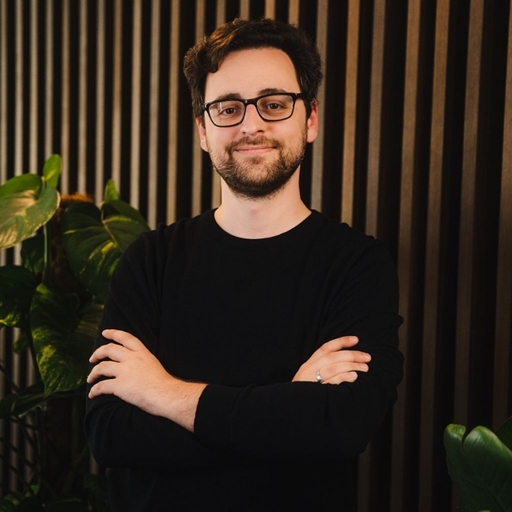
Anton Levitsky
Engineering Leader · AI-native B2B SaaS · Two teams built from scratch
I build engineering organisations and ship AI-native B2B SaaS, with a decade of experience scaling teams from zero through growth and acquisition.
- 0→18 founding org built
- 4→25 team scaled
- 0→12k EUR MRR
- 20 deploys/day
I'm an engineering leader based in Berlin. Over the past decade I've built two engineering organisations from zero — Purpose Green (0 to 18) in proptech and ESG, and REO (4 to 25) in real estate B2B SaaS, which was acquired by Engel & Völkers in 2022. My foundation in high-load systems came from BS PAYONE, where I worked on payment infrastructure handling roughly one billion transactions a year.
What I do well is build teams from zero, ship AI in production, and run high-velocity engineering culture. At Purpose Green that's looked like Claude-powered assistants in customer-facing flows, multimodal document extraction at scale, an internal agent infrastructure, and around 20 production deploys a day on a trunk-based workflow.
Selected work
Purpose Green Real Estate · CTO
Sept 2023 to present Building the engineering function for an ESG/proptech company from zero, with AI as a core capability.
Purpose Green Real Estate · CTO
Sept 2023 to presentBuilding the engineering function for an ESG/proptech company from zero, with AI as a core capability.
— Context
Purpose Green helps real estate owners make their portfolios climate-compliant. I joined as founding CTO with no engineering team and no existing stack. The company needed both an internal operations platform and a customer-facing SaaS product, the Green+ Portal, built from zero in a regulated and audit-heavy domain.
— The problem
Building two product surfaces in parallel with a tiny team meant we couldn’t afford to be slow or to over-architect. We also needed AI not as a feature add-on but as a structural capability, since the work involves heavy document extraction and synthesis from energy certificates, building data, and regulatory inputs.
— What I did
- Built engineering, product, and design from 0 to 18, hiring across backend, frontend, data, and design
- Established trunk-based development with around 20 production deploys per day, real observability, and a clean incident process
- Shipped Claude-powered assistants for customer flows, multimodal document extraction at scale, and internal agent infrastructure on dedicated hardware
- Built the data platform on dbt and AWS Glue, with HubSpot and Stripe integrations feeding a unified analytics layer
- Owned engineering budget over 1M EUR, P&L for the SaaS product line, and OKR planning across engineering, product, and design
- Led technical due diligence on vendor partnerships across data, AI, and proptech APIs
— Outcome
The Green+ Portal launched as a paid SaaS product, AI features moved from experiment to production-grade in customer-facing flows, and the engineering org now operates at the velocity of a much larger company.
— What I learned
AI in production is mostly a data and operations problem, not a model problem. The teams that ship are the ones that own their full lane and reason about reversibility from day one.
REO (acquired by Engel & Völkers Commercial) · Technical Lead
Aug 2020 to Aug 2023 Scaled engineering from 4 to 25 through a marketplace-to-vertical-SaaS pivot and a successful acquisition.
REO (acquired by Engel & Völkers Commercial) · Technical Lead
Aug 2020 to Aug 2023Scaled engineering from 4 to 25 through a marketplace-to-vertical-SaaS pivot and a successful acquisition.
— Context
Joined as Senior Backend Engineer at offmade, a generalist real estate marketplace, and was promoted to Technical Lead within six months. Over the next three years the company pivoted to a focused B2B vertical SaaS for the German real estate market, rebranded to REO, and was acquired by Engel & Völkers Commercial in 2022.
— The problem
The pivot meant rebuilding the platform around a different customer and a different revenue model while continuing to serve the existing user base. The team had to grow fast without losing the cohesion that small teams take for granted.
— What I did
- Scaled engineering from 4 to 25 across backend, frontend, iOS, and infrastructure
- Hired and managed the first engineering managers, set the hiring framework, and ran the technical roadmap with the founders
- Took the SaaS platform from 0 to 12k EUR MRR through the pivot
- Owned the multi-tenant architecture on PHP and PostgreSQL with a GraphQL API, including the platform rebuild that supported the B2B vertical
- Owned engineering budget, contributed to P&L on the SaaS product, and ran OKR planning across the engineering org
- Led the technical side of the integration into Engel & Völkers Commercial post-acquisition
— Outcome
Successful acquisition by Engel & Völkers Commercial in 2022. The platform that supported the acquisition is the same one I had architected and rebuilt during the pivot.
— What I learned
Scale changes the leadership job more than the technical one. The hardest part wasn’t the architecture, it was preserving decision quality as more people joined.
Earlier
BS PAYONE · Senior Backend Engineer
Payment infrastructure handling roughly one billion transactions a year.
How I work
I love writing software, but code is a means, not the point. I write it to solve a real problem for a real user. If the code is elegant and the user problem is unsolved, the work hasn't started yet. Every architecture decision, every hire, every sprint goal traces back to whether it makes the customer's life better. Otherwise it's just craft, and craft on its own doesn't ship value.
People mistake speed for typing fast. Speed is the whole loop: how quickly you move from a question to a researched answer, from a scope to a shipped change, from a customer signal to a learning. Moving fast is the most reliable way to learn fast, and learning is what compounds. Slow teams don't lose to fast teams because they ship less code. They lose because they learn less per quarter.
I'm AI-native, and I use AI in nearly every part of my work: research, scoping, code, writing, decision support, agent infrastructure for the team. Not as a gimmick and not because it's the trend, but because it changes the loop above. The leaders who'll build the best engineering orgs over the next five years are the ones who treat AI as a default tool in their thinking, not a feature on a roadmap. That said, I'm skeptical of AI as a default answer. Most production AI failures are upstream of the model, in the data, the trust budget, and the operational discipline around it.
Most engineering leaders treat people work as overhead. I treat it as the actual product. Build the team like a product: hiring frame, levelling, on-call, performance, the rituals around it. Everything the team ships is downstream of how the team is built. A great codebase produced by a broken org will not stay great, and a clear, well-sequenced org will produce great code almost as a side effect.
Zero tolerance for bullshit. Useless rituals, theatre meetings, decks that exist to be presented, status updates nobody reads. If you spot it, the job is to name it and replace it, not route around it. Time spent on bullshit is time not spent on the user, and the team feels it long before leadership does. The same applies to disagreement: speak up before a decision, not after. I want pushback on the table when it can still change the outcome. Once we've decided, we commit, and we don't re-litigate in the execution. The courage I look for is the courage to challenge, not the comfort of going along.
The last thing, the one most senior leaders get wrong: most of my value is removing decisions, not making more of them. Decisions about platform choices, architecture defaults, what good looks like. When teams have to escalate small calls upward, the system isn't designed well enough. The job is to design the system so the team can move without me, then get out of the way.
Contact
- Email: anton@levitsky.de
- LinkedIn: linkedin.com/in/anton-levitsky